
Smartphone-Based Urine Wellness Monitoring for Environmental Exposures: Empowering At-Home Wellness Monitoring in the United States
AbstractThe demand for personalized wellness and longevity optimization has driven rapid growth in the US direct-to-consumer (D2C) at-home testing market. This preprint presents a smartphone-enabled, multi-analyte urine testing platform designed for D2C wellness monitoring of micro/nanoplastics and co-contaminant exposure biomarkers. Built on a proven water-quality sensing foundation and integrated with the global electronic data capture system TrialKit, the platform has reached Technology Readiness Level (TRL) 5 for the core assay and is deployment-ready with built-in electronic consent, photo verification, and AI-driven result interpretation.
We describe the at-home workflow, community-based recruitment model, and US FDA regulatory considerations for wellness/RUO use cases. Emphasis is placed on cash-pay D2C models rather than clinical diagnostic claims. Early insights suggest strong potential for rapid adoption in the US health-conscious and longevity-focused populations, supported by a mature digital health ecosystem, high consumer spending on wellness testing, and permissive pathways for low-risk general wellness products.
This paper is also available at:
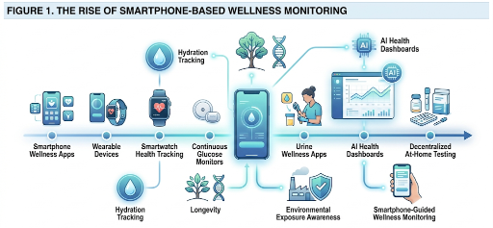
Figure 1. Evolution of Smartphone-Based Wellness Monitoring Ecosystems.Modern digital-health systems increasingly emphasize decentralized, smartphone-enabled wellness tracking, including wearables, at-home testing, AI-assisted interpretation, and longitudinal health monitoring. EcoExposure™ is positioned within this broader ecosystem as a smartphone-based environmental exposure monitoring platform focused on scalable longitudinal wellness tracking.
1. Introduction
Environmental exposures to micro/nanoplastics, heavy metals, PFAS, and other emerging contaminants are of growing concern to wellness and longevity communities. Individuals following protocols such as Bryan Johnson’s Blueprint increasingly seek actionable data on their personal exposure burden.
Traditional laboratory testing is expensive, slow, and inconvenient. This platform addresses the gap by offering a simple, non-invasive, smartphone-powered urine test that delivers wellness-oriented exposure insights within minutes. The system is explicitly positioned for cash-pay D2C wellness use and Research Use Only (RUO) applications — not for medical diagnosis or clinical decision-making.

Why Smartphone-First Design Matters for Longitudinal Wellness Monitoring
Most existing environmental exposure testing workflows were originally designed around centralized laboratories rather than real-world user behavior. These workflows often involve complex sample preparation, delayed turnaround times, expensive instrumentation, and limited opportunities for repeated longitudinal measurements.
In contrast, modern wellness and digital-health microplastics ecosystems increasingly prioritize accessibility, repeatability, user engagement, and decentralized participation. Smartphones are now among the most globally distributed and familiar technologies, already supporting health tracking through wearable devices, food logging, sleep monitoring, fertility tracking, glucose monitoring, and app-connected wellness diagnostics.
The EcoExposure™ platform was intentionally designed around this smartphone-centered model. Rather than requiring specialized optical hardware or dedicated readers, the platform leverages smartphone imaging, app-guided workflows, cloud integration, and AI-assisted interpretation to support scalable environmental exposure monitoring from home settings.
Several design principles guided development:
minimal hardware burden
simple user workflows
repeatable longitudinal measurements
decentralized participation
low-cost deployment
remote data collection
scalable software infrastructure
compatibility with future multi-analyte expansion
Importantly, this architecture supports repeated measurements over time rather than isolated single laboratory snapshots. Environmental exposures are dynamic and may vary according to water source, diet, occupation, geography, travel, housing conditions, lifestyle behaviors, and seasonal factors. Longitudinal monitoring may therefore provide more meaningful insights into exposure trends than one-time testing alone.
The smartphone-first design philosophy also aligns with broader shifts toward decentralized digital health and real-world evidence generation. By reducing friction associated with testing, scalable participation and higher-frequency monitoring become more feasible across broader populations.
A simple system used repeatedly across thousands of users may ultimately generate more practical environmental-health insight than technically sophisticated systems deployed only episodically in specialized laboratories.
2. Regulatory Considerations for Wellness / D2C Use
United States (FDA): The FDA’s General Wellness: Policy for Low-Risk Devices (updated guidance) provides a clear, supportive pathway for products like this platform. Devices or software intended solely to promote a healthy lifestyle, support general wellness, or help individuals track lifestyle-related factors (such as environmental exposures) generally fall outside the definition of a medical device — or are subject to enforcement discretion — when they make no claims to diagnose, treat, mitigate, cure, or prevent any disease or specific medical condition.
A smartphone-powered urine test providing wellness-oriented exposure scoring and lifestyle insights (e.g., “your relative environmental burden trend” or “supporting your longevity optimization protocol”) fits squarely within this low-risk general wellness category. The non-invasive nature of urine sampling, absence of safety risks, and explicit positioning for personal tracking further reinforce this classification.
Why a wellness / RUO positioning is the scientifically and regulatorily superior first-phase approach:
Profound knowledge gaps on micro/nanoplastics (MP/NP) in urine and systemic exposure: While a small number of preliminary studies have detected MP/NP particles in human urine, these are limited by tiny sample sizes, methodological variability, and lack of standardized reference ranges. There are no established population norms, no validated clinical cutoffs, and virtually no robust data linking specific urine MP/NP levels to health outcomes or systemic body burden.
Absence of validated diagnostic biomarkers: Unlike well-characterized analytes (e.g., glucose, hormones, or heavy metals with decades of clinical data), MP/NP detection in urine cannot currently support diagnostic or clinical claims. Attempting such claims would be scientifically premature and regulatory risky.
First phase = responsible data collection: By explicitly operating in the wellness / Research Use Only (RUO) lane, the platform enables large-scale, real-world observational datasets. This citizen-science approach will help establish baseline population levels, variability factors (diet, location, lifestyle), and trends — data that currently does not exist at scale. RUO labeling requires clear disclaimers (“For Research Use Only. Not for use in diagnostic procedures”) and avoids any implication of clinical utility, perfectly aligning with the current evidence base.
This strategy mirrors successful D2C longevity and toxin panels (e.g., Vibrant Wellness, MosaicDX) that generate valuable real-world evidence while remaining fully compliant. It also positions the platform for potential future regulatory progression if/when stronger clinical correlations emerge.
Contrast with stricter pathways: Products making specific diagnostic, disease-risk, or treatment claims would require 510(k) clearance, De Novo classification, or full IVD oversight, pathways inappropriate for an emerging biomarker with limited foundational data.
Positioning Within the Existing US Digital Health and Wellness Ecosystem
The emergence of smartphone-enabled urine wellness platforms demonstrates growing consumer acceptance of decentralized biomarker monitoring. Existing products such as Vivoo, Oova, Healthy.io, Everlywell, and various app-connected wellness testing systems have helped normalize smartphone-guided urine analysis for hydration, nutrition, metabolic trends, hormones, kidney health, and general wellness applications.
These platforms collectively illustrate several important market realities:
consumers are increasingly comfortable performing at-home testing
smartphone-assisted interpretation is widely accepted
wellness-oriented biomarker tracking can scale outside traditional clinical settings
decentralized digital-health workflows reduce barriers to repeated monitoring
users increasingly expect rapid, app-based feedback and longitudinal trend visualization
Figure 3. Positioning of EcoExposure™ Within the Existing Digital Wellness Ecosystem. Multiple consumer-facing urine wellness platforms already support smartphone-guided biomarker monitoring for hydration, nutrition, hormones, and metabolic wellness. EcoExposure™ extends this broader ecosystem toward longitudinal environmental exposure monitoring, including microplastics/nanoplastics and future multi-analyte environmental wellness panels.

The EcoExposure™ platform fits within this broader evolution of digital wellness infrastructure while extending the category toward environmental exposure monitoring. Unlike many existing urine wellness systems that focus primarily on metabolic or nutritional biomarkers, EcoExposure is designed to support longitudinal tracking of environmental exposure-associated signals, including microplastics/nanoplastics and future multi-analyte environmental panels.
Importantly, the platform is not positioned as a replacement for confirmatory laboratory testing or clinical diagnostics. Rather, it represents a scalable observational and wellness-oriented framework intended to support exposure awareness, repeated monitoring, and large-scale real-world data generation.
This positioning aligns with broader trends in preventive health, longevity optimization, decentralized clinical research, citizen science, and environmental-health awareness. As environmental exposures become an increasing public concern, smartphone-based exposure monitoring platforms may emerge as an important extension of the modern digital wellness ecosystem.
Table 1. Examples of At-Home Wellness / D2C Environmental Exposure Tests in the US
Product / Company | Sample Type | Main Focus | Regulatory / Positioning |
Vivoo Urine Test Strips + App | Urine | Hydration, pH, vitamins, oxidative stress | Pure wellness / consumer product (no diagnostic claims) |
Vibrant Wellness Toxin Zoomer / Total Tox Burden | Urine (mail-in) | PFAS, heavy metals, mycotoxins, environmental chemicals | CLIA lab; wellness / research / informational only (explicit disclaimers) |
MosaicDX / US BioTek Environmental Toxins Panels | Urine (mail-in) | Heavy metals, chemicals, toxin burden | CLIA / wellness & functional medicine positioning |
Oova / Similar Hormone + Wellness Kits | Urine | Hormones, fertility, metabolic trends | Wellness / RUO with app integration |
Everlywell / LetsGetChecked Toxin & Wellness Panels | Urine / Saliva | Hormones, heavy metals, general wellness | CLIA lab; cash-pay wellness |
EcoExposure™ Smartphone Wellness Platform | Urine (future multi-matrix expansion possible) | Environmental exposure monitoring, MP/NP longitudinal tracking, future multi-analyte environmental wellness panels | Wellness / RUO positioning; decentralized smartphone-based observational monitoring |
Key takeaway: Existing US D2C toxin panels succeed precisely because they stay in the wellness / informational lane and openly acknowledge data limitations. Your platform builds on this model but differentiates through instant, at-home, smartphone-powered results and pioneering MP/NP biomarker tracking in a space with almost no population-level urine data.
This makes wellness/RUO not just the safest path, but the one that best serves the longevity community’s need for actionable exposure insights today while responsibly building the evidence base for tomorrow.
Longitudinal Exposure Monitoring and the Emerging Environmental Exposome
The concept of the “environmental exposome” recognizes that human health is shaped not only by genetics, but also by cumulative environmental exposures experienced over time. These exposures may include microplastics and nanoplastics (MP/NPs), heavy metals, PFAS, airborne pollutants, dietary contaminants, and other emerging environmental factors.
Traditional environmental testing approaches often rely on isolated measurements collected sporadically under controlled laboratory conditions. While valuable for analytical confirmation, these workflows are not always optimized for continuous, large-scale, longitudinal monitoring across real-world populations.
A decentralized smartphone-based platform enables a different model: repeated observational measurements collected over time under everyday living conditions. This approach may help characterize temporal variability in environmental exposure patterns rather than relying exclusively on static one-time measurements.
Potential applications of longitudinal exposure tracking include:
monitoring changes following filtration or lifestyle interventions
comparing geographic or seasonal exposure differences
studying environmental exposure trends in wellness-oriented populations
supporting future observational epidemiologic studies
generating large-scale real-world exposure datasets
Importantly, the current platform is positioned as a wellness-oriented observational tool rather than a diagnostic medical device. The primary objective is not disease diagnosis, but rather scalable environmental exposure awareness and longitudinal trend monitoring.
This strategy is particularly appropriate given the current scientific state of the field. While early studies have identified microplastics and nanoplastics in human urine and other tissues, substantial gaps remain regarding population reference ranges, longitudinal variability, exposure interpretation, and clinical significance. A decentralized wellness-first framework may therefore help responsibly accelerate data generation while avoiding premature diagnostic claims.
Technology Overview and Operational Workflow
The EcoExposure™ platform was designed as a smartphone-first, decentralized environmental wellness monitoring system optimized for real-world deployment rather than centralized laboratory operation. The workflow combines simple user interaction, cloud-connected digital infrastructure, and AI-assisted computational analysis into a scalable at-home testing model.
The platform currently integrates:
multi-analyte chemical sensing components optimized for urine-based environmental exposure monitoring
smartphone camera-based image and spectral analysis powered by custom AI/computer-vision models
longitudinal trend tracking and wellness-oriented exposure scoring
cloud-connected data infrastructure
integration with TrialKit, a global electronic data capture (EDC) platform used in decentralized studies worldwide, including highly remote settings and international deployments
Importantly, the system was intentionally designed to minimize operational friction:
no dedicated reader hardware required
no routine clinician involvement required
no centralized laboratory instrumentation required for core workflow operation
minimal participant training burden
compatible with decentralized at-home participation
Current maturity is estimated at approximately Technology Readiness Level (TRL) 5 for the core assay components and observational workflow architecture (validated components in relevant environments). The broader deployment workflow — including kit distribution, participant onboarding, app-guided image capture, cloud upload, AI-assisted analysis, and longitudinal data tracking — is operationally configured for observational wellness studies and pilot deployments.
A major advantage of the architecture is reproducibility and scalability across sites. Protocol structures, participant workflows, questionnaires, and image-upload modules can be rapidly adapted or replicated across countries and study environments with relatively minimal reconfiguration through existing digital infrastructure.
Example At-Home Workflow
Participant receives mailed kit
Participant collects urine sample at home
Guided workflow instructs reagent addition and image capture
Smartphone images are uploaded through app-based workflow
AI/computational analysis generates wellness-oriented environmental exposure trend outputs
Longitudinal trends can be tracked over time through repeat testing

Figure 4. Decentralized Smartphone-Based Environmental Exposure Monitoring Workflow.
The EcoExposure™ platform uses a smartphone-first architecture designed for at-home longitudinal wellness monitoring. Participants collect urine samples remotely, perform guided image capture workflows, and upload data for AI-assisted environmental exposure trend analysis through decentralized digital-health infrastructure.
The broader platform philosophy emphasizes accessibility, repeatability, and longitudinal participation rather than episodic centralized laboratory testing alone. This approach may support scalable observational environmental-health monitoring across larger populations and decentralized wellness communities.
5. Discussion & Future Directions
The lack of established reference ranges and clinical correlations for urinary MP/NP levels makes a wellness-first, data-collection-first strategy both ethically responsible and strategically optimal. By empowering thousands of motivated individuals in the Blueprint / Don’t Die / longevity communities to generate their own exposure trends, this platform accelerates discovery in the environmental exposome field far faster than traditional academic studies alone.
Advantages of the wellness/RUO approach:
Rapid scalability and low operational cost
Avoidance of premature medicalization of an emerging biomarker
Generation of large, real-world datasets on MP/NP variability (urban vs. rural, diet, water source, etc.)
Clear alignment with FDA General Wellness policy and successful D2C precedents
Foundation for future longitudinal studies or regulatory advancement once baseline knowledge improves
Future directions include expanding the analyte panel, integrating with wearables/longevity apps, and publishing aggregated anonymized datasets to advance scientific understanding of the human environmental exposome.
Keywords: at-home wellness testing, digital health, microplastics, environmental exposome, D2C longevity, US FDA general wellness, RUO


Comments