
Why Plastic Interfaces Matter in Human Biological Fluids
Why Plastic Interfaces Matter in Human Biological Fluids
A study published in Nature on 14 October 2026, “Intrinsic physicochemical activity at microplastic–water interfaces,” provides experimental evidence that common microplastics can generate reactive oxygen species through processes occurring at their interfaces with water. The findings challenge the assumption that the chemical inertness of bulk plastic necessarily extends to fragmented particles.
For me, this reinforces a question central to our research: What happens when plastic surfaces encounter the complex environments of human biological fluids?
My MP/NP research program began in 2024 with proposed detection and intervention approaches involving plastics in biological systems. Subsequent work has investigated surface-mediated interactions, reagent-driven aggregation, and optical responses, including assay development involving urine.
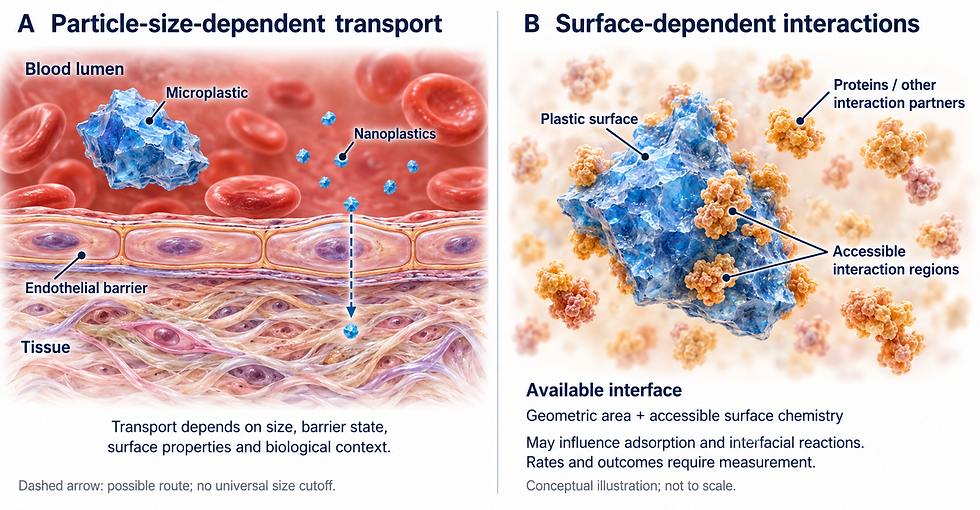
The broader research direction considers particle surfaces as interfaces whose interactions with surrounding molecules may inform detection and, potentially, future mitigation approaches. Human biological fluids introduce additional complexity: proteins, salts, and other constituents may alter particle behavior and the surfaces available for interaction.
In my research, I distinguish geometric surface area from partner-specific functional accessibility: which regions are available to interact with a particular molecule or reagent under defined conditions. This distinction helps frame questions about assay responses, aggregation, and possible biological interactions beyond particle mass or count alone.
The Nature study supplies an important mechanistic contribution, including experiments involving biomolecules and cells. My work explores related questions in biological-fluid detection and proposed intervention development. These connections motivate further investigation; they do not establish clinical diagnostic utility, therapeutic efficacy, or a universal mechanism of disease.
The next step is careful, system-specific validation—connecting measurable particle interactions with reproducible analytical performance and independently assessed biological outcomes.
Read my research perspective and development timeline. From Plastic Surface Chemistry to the Z-Model: Surface Area, Interfacial Reactivity, and the Evolution of a Cross-Domain Research Framework (2024–2026) https://doi.org/10.5281/zenodo.23425774 Melinda B. Chu, M.D., M.B.A. CEO & Founder, Inventor


Comments