
Toward Scalable Detection of Microplastics and Nanoplastics in Human Biological Systems: Alignment with STOMP Objectives and Preliminary Feasibility Data
Abstract:
Microplastics and nanoplastics (MNPs) are increasingly detected in human blood, urine, and tissues, yet scalable, non-destructive methods for routine systemic exposure measurement remain unavailable. Current laboratory techniques are destructive, low-throughput, and unsuitable for longitudinal or population-scale monitoring. The ARPA-H STOMP program identifies scalable measurement, mechanistic insight, and eventual removal as priority needs. Here we describe a non-destructive, image-based optical framework that detects emergent interaction signatures in intact biofluids. Preliminary experiments in spiked urine and blood-relevant matrices demonstrate reproducible spatial and temporal patterns consistent with MNP presence, including earlier signal formation under nanoplastic conditions. An ongoing volunteer-based calibration study is evaluating biological variability and repeatability. This approach offers a pathway toward decentralized, high-throughput MNP monitoring that directly supports STOMP objectives.
Keywords: microplastics, nanoplastics, ARPA-H STOMP, biofluid detection, non-destructive optical imaging, Poisson sampling, large-volume analysis, urine, blood, ecotera EcoExposure
This paper is also available at:
1. Introduction
Microplastics and nanoplastics (MNPs) have been identified in human blood, urine, placenta, brain, and other tissues, raising concerns about systemic exposure and potential health effects. Despite increasing evidence of their presence, the field lacks a scalable framework for measuring total MNP burden in living individuals.
Existing methods—including Raman spectroscopy, μFTIR, and pyrolysis–GC/MS—are limited by high cost, low throughput, and reliance on destructive sample processing. These constraints prevent routine measurement, limit reproducibility across studies, and restrict investigation of temporal exposure dynamics.
The ARPA-H STOMP program highlights these challenges, emphasizing the need for:
scalable measurement technologies
improved understanding of biological interactions
eventual development of removal strategies
Addressing these needs requires a shift from laboratory-bound, particle-isolation methods to scalable systems capable of detecting MNP-associated signals in intact biological samples.
2. Limitations of Current Measurement Frameworks
Current approaches to MNP detection suffer from several key limitations:
Laboratory Dependence: Requires specialized equipment and trained personnel
Destructive Processing: Filtration, digestion, or polymer breakdown alters sample integrity
Low Throughput: Typical processing times range from hours to days per sample
Size Bias: Many methods fail to detect nanoplastics or underrepresent smaller particles
Sampling Instability: Small-volume sampling introduces stochastic (Poisson) variability
As a result, reported MNP levels vary widely across studies, reflecting methodological inconsistency rather than true biological variability.
These limitations prevent scalable, longitudinal monitoring of human exposure and represent a fundamental barrier to advancing the field.
Table 1. Comparison of Conventional Lab-Based Methods with EcoExposure platform
Category | Conventional Lab-Based Methods | EcoExposure™ |
Infrastructure | Specialized laboratory required | Decentralized workflow |
Workforce | Requires specialized laboratory expertise and hands-on training | No specialized training required |
Throughput | Low (days per sample) | High (minutes per sample) |
Scalability | Limited by equipment and personnel | Designed for population-scale deployment |
3. Poisson Sampling Considerations in Biological Fluids
Measurement of microplastics and nanoplastics (MNPs) in biological fluids such as urine and blood is subject to fundamental sampling constraints, particularly at low particle concentrations. When discrete particles are sparsely distributed within a fluid, their detection follows Poisson statistics, where the probability of observing a given number of particles depends on both concentration and sampled volume. In small-volume samples, this leads to high variability and a significant likelihood of zero-particle observations despite true underlying presence, resulting in underestimation and poor reproducibility. These effects are amplified in biological matrices, where heterogeneous particle distributions and complex fluid dynamics further contribute to sampling uncertainty. Approaches that rely on limited aliquots or particle counting are therefore inherently sensitive to stochastic variation. Increasing effective sampling volume and capturing system-level interaction signatures, rather than relying solely on discrete particle enumeration, can mitigate these limitations and enable more stable and reproducible measurement of MNP-associated signals in biological systems.
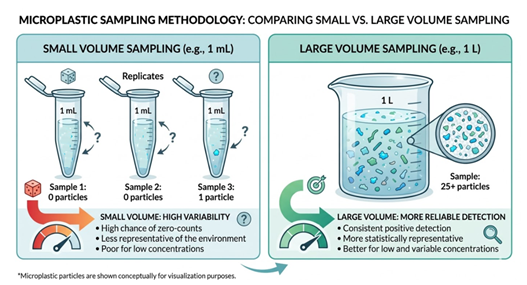
Figure 1. Conceptual illustration of Poisson sampling effects in biological fluids.At low particle concentrations, microplastics and nanoplastics are sparsely and randomly distributed in fluids such as urine and blood. Small sample volumes result in high variability and a significant probability of zero-particle detection, even when particles are present. Increasing effective sample volume improves detection reliability by increasing the expected particle count (λ) and reducing false-negative probability.
4. A Scalable Optical Detection Framework
We present a non-destructive detection framework based on optical interaction signatures in intact liquid systems.
Rather than isolating and counting particles, this approach measures emergent spatial and temporal patterns arising from particle–matrix interactions.
Key Features:
Non-destructive (no filtration or digestion)
Compatible with intact biological samples
Large-volume sampling reduces stochastic error
Image-based analysis enables computational scalability
Does not require specialized laboratory expertise
This framework shifts detection from particle identification to system-level interaction measurement, enabling detection across heterogeneous and mixed particle populations.
5. Detection in Biological Matrices
5.1 Urine as a Scalable Matrix
Urine represents a non-invasive, repeatable matrix suitable for longitudinal monitoring of systemic exposure.
In controlled experiments using spiked human urine samples:
Samples appeared visually similar to the naked eye
Reproducible differences in optical structure were observed
Differences included spatial heterogeneity and temporal evolution
Nanoplastic-associated conditions demonstrated:
earlier signal formation
increased spatial organization
stronger interaction signatures at low concentrations
These findings support the feasibility of detecting MNP-associated signals in urine using non-destructive optical methods.

Figure 2. Grayscale comparison of representative urine samples under differing particulate conditions. Samples appear visually similar but exhibit differences in spatial uniformity and optical structure. These variations are consistent with underlying particulate interactions within the matrix and are not attributable to gross visual differences alone.
5.2 Blood-Relevant Matrices
Blood provides a clinically relevant matrix reflecting systemic circulation and potential biological interaction.
In simulated blood systems:
Optical signatures consistent with particle-associated interactions were observed
Nanoplastics produced earlier and more pronounced signal formation compared to microplastics
Observed patterns were consistent with surface-area–dependent interaction dynamics
These findings support feasibility for future development of scalable blood-based monitoring systems.
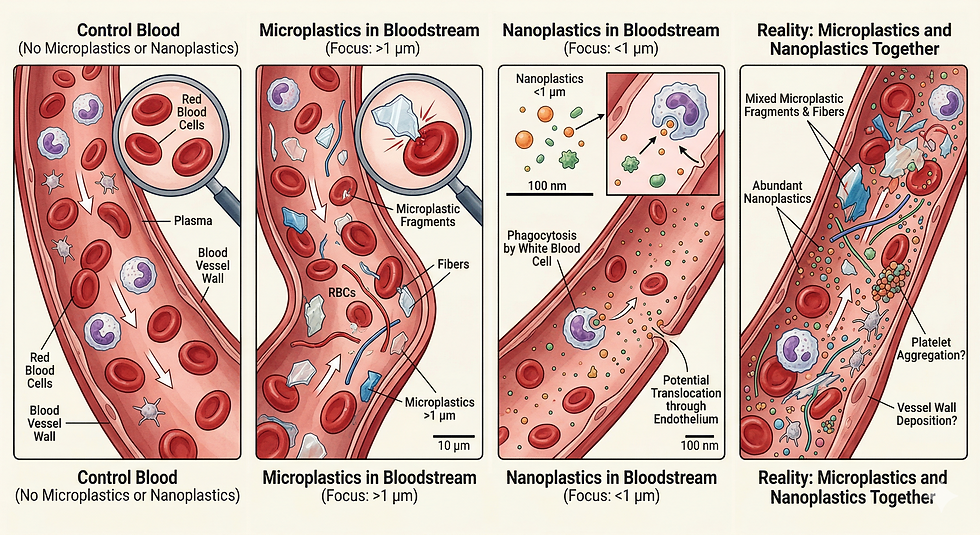
Figure 3. Conceptual representation of microplastic and nanoplastic behavior in blood-relevant environments. Control blood (left) demonstrates baseline cellular and plasma structure. Microplastics (>1 μm) are typically present as irregular fragments and fibers, interacting with circulating components. Nanoplastics (<1 μm) exhibit distinct behavior, including higher dispersion, potential cellular interactions, and increased surface-area–driven activity. In real-world conditions (right), microplastics and nanoplastics coexist, forming heterogeneous systems with mixed particle types, spatial distributions, and potential interactions with vascular and immune components. This schematic highlights the complexity of particle behavior in biological matrices and the importance of detection approaches that capture heterogeneous, non-uniform particulate systems.
6. Mechanistic Interpretation
Observed optical behavior is consistent with a surface-area–driven interaction model, in which:
Nanoplastics exhibit higher interaction potential due to increased surface area
Early formation of structured spatial domains occurs
Mixed microplastic and nanoplastic systems produce heterogeneous interaction patterns
Importantly:
Signals are not attributable to random biological debris
Patterns are reproducible across conditions
Behavior persists across environmental and biological matrices
This suggests that detection is governed by interaction dynamics, rather than particle count alone.
7. Alignment with STOMP Objectives
This framework directly aligns with key STOMP priorities:
Measurement
Enables scalable detection in biological systems
Avoids limitations of current laboratory methods
Mechanistic Understanding
Captures interaction dynamics and particle behavior
Provides insight into differences between micro- and nanoplastics
Translation Potential
Compatible with decentralized and high-throughput deployment
Supports longitudinal and population-level monitoring

Figure 4. Scalable framework for biological microplastic and nanoplastic monitoring. Individuals provide biological samples (urine and blood), which are analyzed using non-destructive optical detection methods within 30–60 minutes. Extracted signal features are aggregated to generate population-level exposure maps. These data support clinical interpretation and enable informed decision-making for personalized risk assessment and broader public health applications.
8. Early Volunteer-Based Calibration Study
To support translation toward real-world application, an early-stage volunteer-based study has been initiated.
Objectives:
Establish calibration ranges across biological variability
Evaluate repeatability and signal stability
Characterize within-subject vs. between-subject variation
Refine signal classification thresholds
This study represents a first step toward:
longitudinal exposure monitoring
population-scale measurement
integration into clinical or research workflows
9. Implications for Public Health and Research
A scalable framework for MNP detection enables:
Routine monitoring of environmental exposure
Longitudinal studies linking exposure to disease
Improved understanding of exposure dynamics
Expansion beyond small-cohort laboratory studies
By transforming MNP detection into a scalable measurement problem, this approach supports proactive health strategies and aligns with emerging priorities in environmental health.
10. Conclusion
Microplastic and nanoplastic exposure remains poorly characterized due to limitations in current measurement approaches.
The framework presented here demonstrates the feasibility of:
detecting MNP-associated signals in biological samples
capturing interaction dynamics without destructive processing
enabling scalable, repeatable measurement
These capabilities position this approach as a candidate for advancing STOMP objectives and supporting future clinical and population-level applications.


Comments